A non-invasive peripheral neural interface enables the intuitive control of assistive devices
This study is about giving paralyzed people back control over their limbs — with the help of technical aids in the form of neuro-orthoses.
The basic idea: movement in the body is controlled by what are known as motor neurons. These are nerve cells that send signals from the spinal cord to the muscles. Earlier research has shown that these nerve signals are still present in people with spinal cord injuries — even below the site of injury, where the muscles are paralyzed. The muscles no longer receive enough signal to move visibly, but a small amount of residual activity can still be measured.
It is precisely this residual activity that we want to make use of. Using artificial intelligence and specialized mathematical methods, the nerve signals are read out and translated into control commands. This technique is called a peripheral neural interface.
A paralyzed hand should, for example, be able to move again by having a neuroorthosis take over the movement — controlled solely by the patient’s remaining muscle and nerve activity. So far, it has been shown that the neuro-orthosis can be controlled very precisely in this way, because individual nerve cells can be specifically read out.

Aims of the study

Measuring muscle activity
By placing biosensors on the forearm of the affected limb, we measure the residual muscle activity during hand movements. Here, we want to find out how much activity remains after neuromuscular impairments resulting from, for example, stroke or spinal cord injury.
Detecting movement intentions
Using artificial intelligence, we recognize your movement intentions from the measured muscle signals. In this study, we are investigating how many different hand-movement intentions we can read out from your forearm in parallel.

Controlling an assistive device
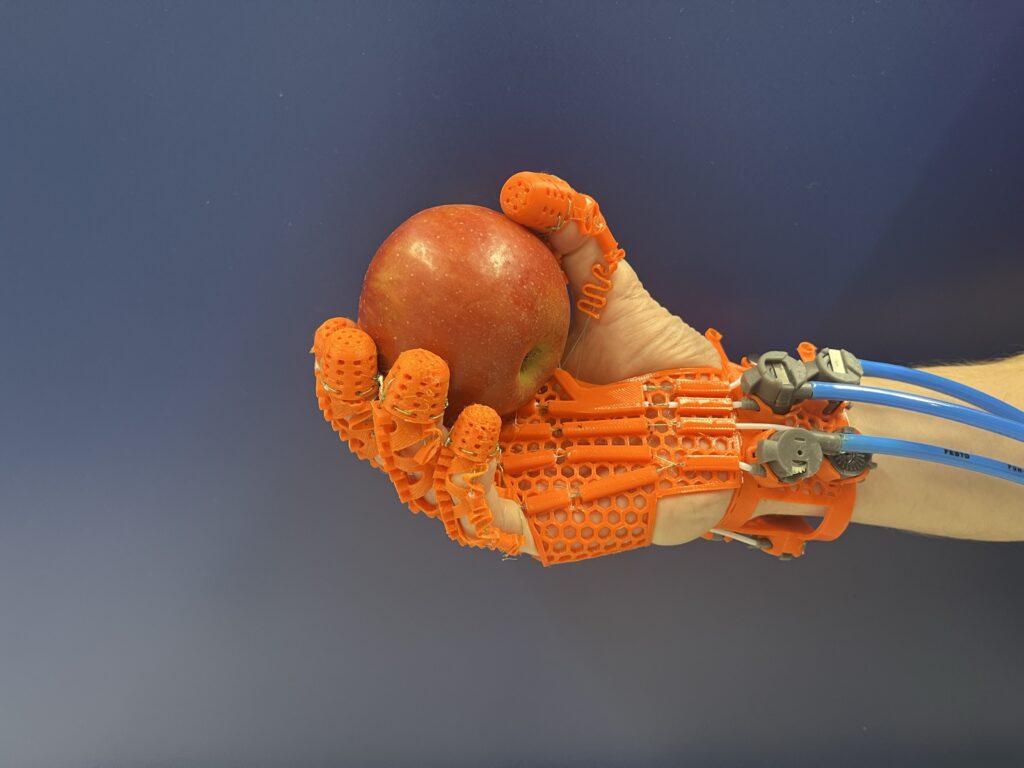
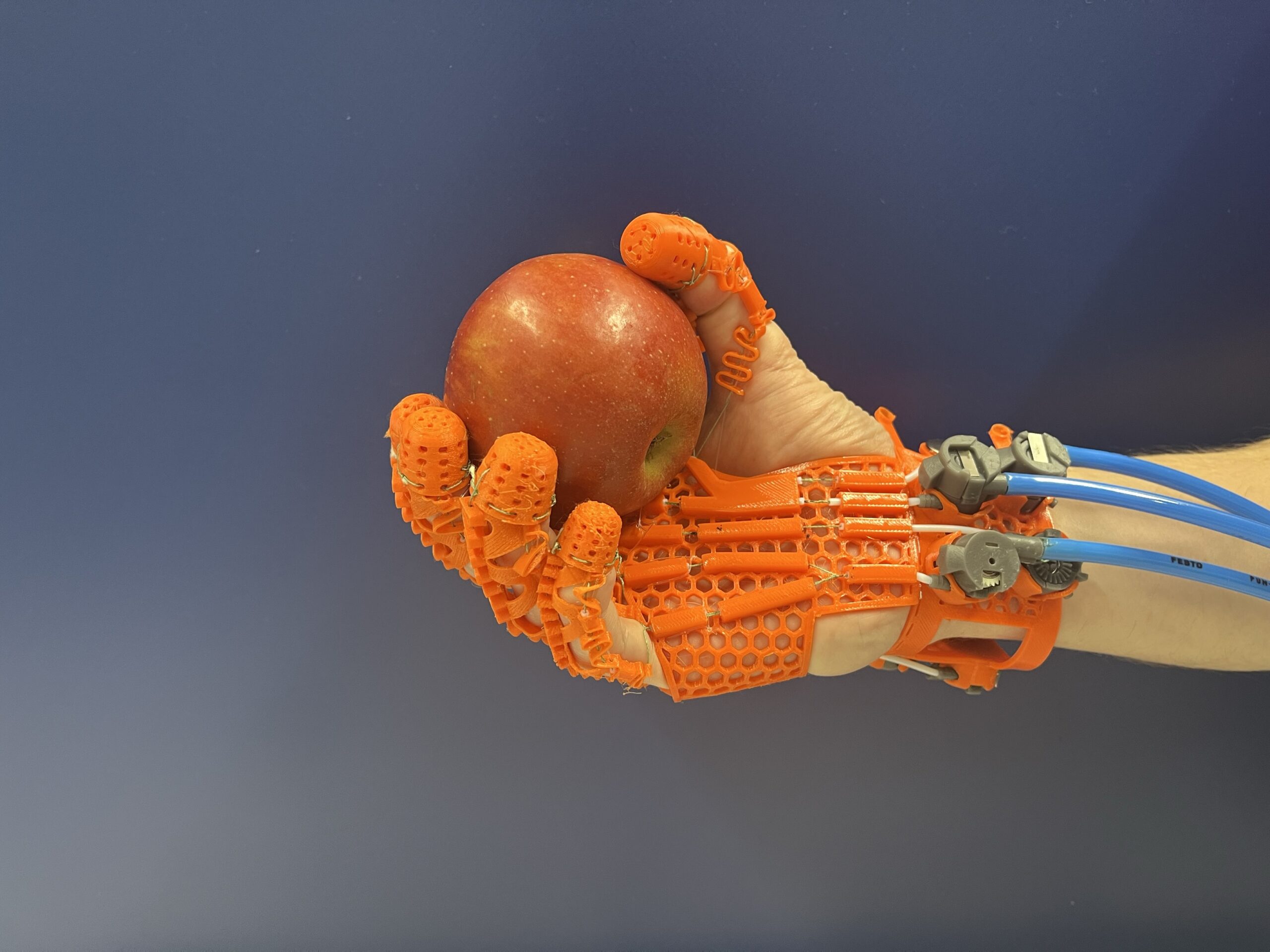
Once movement intentions have been identified, we transfer them to the motors of a neuroorthosis to perform a real movement. To do this, we attach the entire system — sensors and the mechanical orthosis — to your hand and forearm. In this part of the study, we want to find out how precisely and skillfully you can operate these aids, and how usable the systems prove to be in practice.
What to expect
Initial contact: information and orientation
Once you have contacted us by phone or email, we arrange a short online meeting via Microsoft Teams. In it, we present the study, explain how it works, and tell you what taking part will actually mean for you. You’ll have all the time you need to ask questions in this conversation.
Session 1: measuring muscle activity
The first session takes place in our laboratories in Erlangen. We attach hundreds of fine sensors to your forearm and record muscle activity during various hand movements. Even the smallest signals are captured this way. The examination itself is painless and non-invasive.
Analysis of your signals
After the first session, we analyze the recorded data and check whether clear movement intentions can be identified from your residual muscle activity. We will inform you of the result — whatever it turns out to be.
Session 2: first training with GraspAgain
If your muscle activity translates well into movement intentions, we arrange a second appointment. In this session, you first practice controlling our GraspAgain neuroorthosis in a virtual environment. Afterwards, we conduct an initial functional test directly with the neuroorthosis.
Session 3: use in everyday scenarios
In the third session, GraspAgain comes into practical use: you control the neuroorthosis through your own muscle activity and reach for everyday objects — whenever you like, completely naturally. We also carry out standardized tests to evaluate function objectively. One thing is at the center of all this: that you can grasp again, self-determined and independent.
Who can take part?
You’re a good fit for our study if the following points apply to you:
- You are between 18 and 75 years old.
- You live with a neuromuscular impairment following a spinal cord injury, stroke, or other causes, and you would like to regain hand and gripping function.
- You are motivated and curious about being closely involved in innovative cutting-edge research, and about contributing to turning this research into a real solution for those affected.
- You bring the drive to stay the course and to relearn grasping, step by step, with our GraspAgain neuroorthosis.
- You are able to come to Erlangen for the sessions.
Contact
| Dominik Braun | Research associates | Phone: +49 9131 85-71375 | Email: dome.braun@fau.de |
| Nico Weber | Research associates | Email: n1co.weber@fau.de |
Partners & Project Sponsors